Support our educational content for free when you purchase through links on our site. Learn more
Best Tablet for Todlers: 10 Picks Parents Can Trust 🧸

For most families, the Amazon Fire HD 8 Kids is the best tablet for toddlers: it’s a practical size, comes with a protective kids’ case, and offers child-focused parental controls. If your family already uses Apple devices, an iPad with a rugged case and carefully configured Screen Time is a flexible alternative.
We compared toddler-friendly options with parent priorities in mind: durability, simple controls, age-appropriate apps, and how easy a tablet is to pack for a trip. One lesson from families is wonderfully unglamorous: the tablet that saves the day on a flight is usually the one someone remembered to charge—and load with offline stories.
Age matters, too. The American Academy of Pediatrics advises avoiding screen media for children under 18 months except video chatting, and choosing high-quality content with adult involvement for young toddlers.
Key Takeaways
- Best all-around toddler pick: Amazon Fire HD 8 Kids balances manageable size, a protective case, and child-focused controls.
- Best for Apple families: Choose an iPad or iPad mini with a sturdy case and Apple Screen Time set up before use.
- Prioritize protection and controls: A snug, shock-absorbing case and purchase restrictions matter more than premium specs.
- Check apps and offline access: Confirm your preferred apps work on the tablet, then test downloaded content before travel.
- Keep screen use intentional: Follow age-appropriate guidance and make space for sleep, active play, books, and family time.
👉 Shop the leading picks:
- Amazon Fire HD 8 Kids: Amazon | Walmart
- Amazon Fire HD 10 Kids: Amazon | Walmart
- Apple iPad: Apple | Amazon
- Samsung Galaxy Tab A9+: Samsung | Amazon
- Browse more kid-friendly tablets and tablet comparisons.
Table of Contents
- ⚡️ Quick Tips and Facts: Best Tablet for Todlers
- 🧸 Why Choose a Tablet for a Toddler? Background and Basics
- 🏆 Best Tablets for Todlers: 10 Picks for Play, Learning, and Family Life
- 1. Amazon Fire HD 8 Kids: Best Overall Toddler Tablet
- 2. Amazon Fire HD 10 Kids: Best Large-Screen Tablet
- 3. Amazon Fire 7 Kids: Best Compact Budget-Friendly Pick
- 4. Apple iPad: Best Premium Tablet for Todlers
- 5. Apple iPad mini: Best Small Tablet for Little Hands
- 6. Samsung Galaxy Tab A9+: Best Android Tablet for Families
- 7. Samsung Galaxy Tab A9: Best Compact Android Tablet
- 8. Lenovo Tab M9: Best Tablet for Casual Toddler Use
- 9. Amazon Fire HD 10 Kids Pro: Best for Todlers Growing Into Bigger Kids
- 10. Refurbished Apple iPad: Best Value for an iPad Family
- 📊 Toddler Tablet Comparison: Screen, Battery, Durability, and Parental Controls
- 🔍 How to Choose the Best Tablet for a Toddler
- Screen Size, Weight, and Ergonomics for Little Hands
- Durability, Kid-Prof Cases, and Drop Protection
- Battery Life, Storage, and Offline Downloads
- Wi-Fi, Cellular, and Travel-Friendly Features
- 🔒 Parental Controls, Screen Time Limits, and Safe Browsing
- Amazon Kids, Apple Screen Time, and Google Family Link
- App Store Safety, In-App Purchases, and Ads
- Privacy, Cameras, Microphones, and Location Settings
- 🎨 Best Toddler Apps, Learning Games, and Videos
- Educational Apps for Early Learning
- Drawing, Music, Stories, and Creative Play
- Offline Content for Road Trips and Flights
- ⏱️ Healthy Screen Time for Todlers
- Age-Based Screen Time Guidance
- Tips for Co-Viewing and Screen-Free Transitions
- When to Put the Tablet Away
- 🛡️ Tablet Safety, Cleaning, and Accessories
- Protective Cases, Screen Protectors, and Stands
- Charging Safety and Cable Management
- How to Clean a Toddler’s Tablet
- 💡 Quick Setup Tips for a Toddler-Friendly Tablet
- 💬 Common Tablet-Buying Mistakes to Avoid
- 🏁 Conclusion
- 🔗 Recommended Links
- ❓ FAQ
- What is the best tablet for a 2-year-old?
- Is an Amazon Fire tablet or an iPad better for toddlers?
- How much screen time should a toddler have?
- Can toddlers use tablets without Wi-Fi?
- Do toddlers need a tablet with a kid-proof case?
- What size tablet is easiest for a toddler to hold?
- 📚 Reference Links
⚡️ Quick Tips and Facts: Best Tablet for Todlers
The best tablet for a toddler isn’t necessarily the fastest or fanciest. It’s the one you can protect, set up safely, and put away without a family summit. For many households, that means a small tablet with a rugged case and straightforward parental controls.
If drops are part of your household’s product-testing routine, our guide to 12 durable tablets for kids that survive every drop in 2026 is a useful companion.
| Quick question | Our short answer |
|---|---|
| Best all-around toddler-focused pick | Amazon Fire HD 8 Kids |
| Best for a smaller budget and smaller hands | Amazon Fire 7 Kids |
| Best bigger screen | Amazon Fire HD 10 Kids |
| Best for a family already using Apple devices | Apple iPad with a sturdy case |
| Best Android family tablet | Samsung Galaxy Tab A9+ with parental controls configured |
| What matters most | Durability, age-appropriate content, parental controls, and a comfortable size |
| A note on age | The American Academy of Pediatrics (AAP) recommends avoiding screen media for children younger than 18 months, except video chatting. For ages 18–24 months, introduce high-quality media with an adult; for ages 2–5, limit routine screen use to about one hour a day of high-quality content. |
Our parent takeaway: Buy the case before handing over the tablet, download travel content before leaving Wi-Fi, and decide the stop time before pressing play. Tiny fingers are excellent at finding the “one more video” button.
Explore our kid-friendly tablets and educational tablets guides for more options.
🧸 Why Choose a Tablet for a Toddler? Background and Basics
A tablet can support a shared story, a video call with grandparents, or a carefully chosen learning activity. It can also become a noisy rectangle that follows everyone from room to room. The difference is usually how, when, and with whom it’s used, not just the logo on the back.
The AP recommends making media choices with a child’s age, content, and family routines in mind. Its Family Media Plan tool can help families set practical boundaries around screens, sleep, meals, and play.
What a toddler tablet should—and shouldn’t—do
A good tablet for toddlers should:
- Be comfortable for a small child to hold or use on a stable surface.
- Have a ruged, well-fitting case with protected corners.
- Let an adult manage profiles, downloads, web access, and purchases.
- Work offline for pre-downloaded books, shows, or games when traveling.
- Make it easy to stop, lock, or hand back to an adult.
It doesn’t need to:
- Be a top-tier gaming machine.
- Have a large collection of apps installed.
- Replace outdoor play, books, conversation, or sleep.
- Be owned by the toddler. A shared family device is often a sensible first step.
A note about age and screen recommendations
Screen guidance varies by age and organization, so check the advice relevant to your child and discuss individual concerns with their pediatrician. The AP’s guidance distinguishes between infants, toddlers, and preschoolers; it emphasizes choosing high-quality content and, for young children, watching or using media together where possible. See the AAP’s media guidance and the World Health Organization’s guidance for children under five.
We’ve heard two reasonable parent perspectives: one family likes having a tablet ready for a long flight; another would rather keep screens occasional and shared. Those aren’t contradictory. A tablet can be useful without becoming a default activity.
🏆 Best Tablets for Todlers: 10 Picks for Play, Learning, and Family Life
The ratings below are our editorial assessment of toddler suitability, not laboratory results. They weigh durability, ease of use, parental controls, content, portability, and flexibility. A model’s exact configuration, software support, and included accessories can vary by region and generation, so verify the listing before buying.
| Tablet | Design | Functionality | Parental controls | Toddler durability | Best for |
|---|---|---|---|---|---|
| Amazon Fire HD 8 Kids | 9/10 | 8/10 | 9/10 | 9/10 | Best all-around toddler-focused pick |
| Amazon Fire HD 10 Kids | 8/10 | 8/10 | 9/10 | 9/10 | Larger screen and shared viewing |
| Amazon Fire 7 Kids | 9/10 | 7/10 | 9/10 | 9/10 | Compact size and travel |
| Apple iPad | 8/10 | 10/10 | 9/10 | 6/10* | Apple families and broad app choice |
| Apple iPad mini | 9/10 | 10/10 | 9/10 | 6/10* | Small premium tablet |
| Samsung Galaxy Tab A9+ | 8/10 | 8/10 | 8/10 | 6/10* | Family Android use and a larger display |
| Samsung Galaxy Tab A9 | 9/10 | 7/10 | 8/10 | 6/10* | Compact Android family tablet |
| Lenovo Tab M9 | 8/10 | 7/10 | 7/10 | 6/10* | Basic shared use |
| Amazon Fire HD 10 Kids Pro | 7/10 | 8/10 | 9/10 | 8/10 | Older children who want a slimmer design |
| Refurbished Apple iPad | 8/10 | 9/10 | 9/10 | 6/10* | Apple features with a refurbished-device option |
*The rating reflects the tablet without a toddler-grade protective case. A robust case can improve drop protection, but no consumer tablet is truly toddler-proof.
1. Amazon Fire HD 8 Kids: Best Overall Toddler Tablet
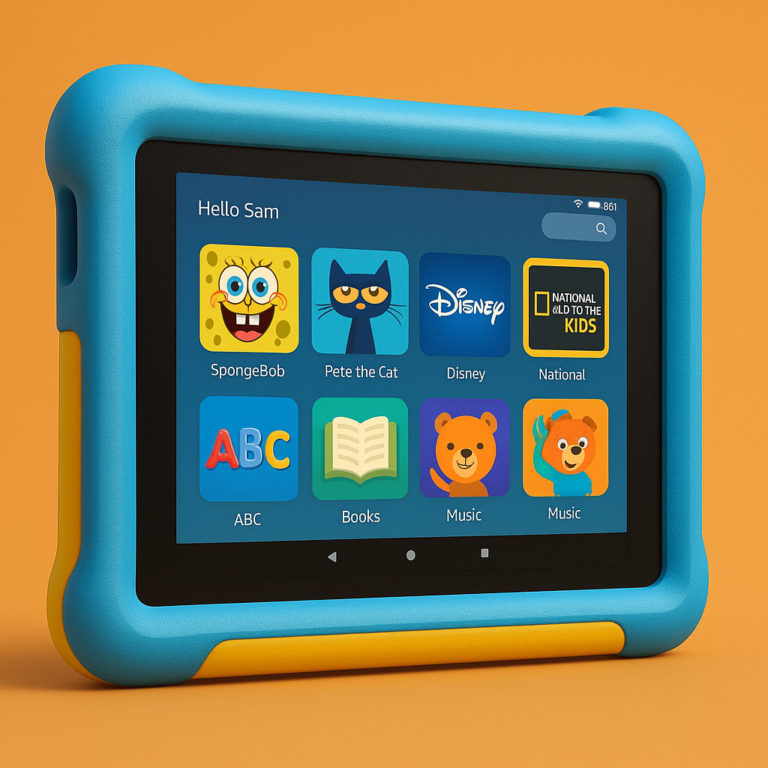
For many families, the Amazon Fire HD 8 Kids hits the useful middle: a screen larger than a phone, a manageable size for young children, and a protective case bundled with kids’ editions. Amazon’s Fire HD 8 Kids product page has the current generation and package details; check the included warranty and subscription terms because offers can change.
Why we like it:
- The 8-inch class is a practical compromise between portability and visibility.
- Amazon Kids parental controls support child profiles and content restrictions; see Amazon Kids parental controls.
- A thick case is typically included with the Kids edition.
- It can suit families looking for a dedicated child profile rather than a shared adult home screen.
Tradeoffs:
- The Amazon app ecosystem differs from Google Play and Apple’s App Store. Check that the specific apps your child needs are available before buying.
- Some content features require an Amazon Kids+ subscription after any included trial.
- Larger foam cases add bulk, and the interface may feel busy to adults who prefer a simpler app grid.
- A family who relies on Google apps or a particular streaming service should verify compatibility first.
TechGearLab’s testing summary calls the Fire HD 8 Kids a strong choice for younger children and reports 570 minutes (9.5 hours) in its video-battery test for the model it evaluated. That’s a test result for a specific generation and test setup, not a guarantee for every tablet. See its kids’ tablet test and rankings.
Parent perspective: We like a device that arrives with the child profile and case in mind. But we still recommend opening it first, setting the limits, and testing offline downloads before presenting it as the surprise travel companion. The surprise is more fun when it isn’t followed by “Why won’t this app open?”
👉 CHECK PRICE on:
- Amazon Fire HD 8 Kids: Amazon | Walmart | Amazon Devices
2. Amazon Fire HD 10 Kids: Best Large-Screen Tablet
The Amazon Fire HD 10 Kids is a good fit when the tablet will be used on a table, propped on a stand, or shared with a parent. The larger display can make picture books and videos easier to see, but it’s less convenient for a toddler to carry than a smaller model.
Upsides
- Larger screen for shared reading, video calls, and picture-heavy apps.
- Kids’ edition commonly pairs a protective case with child-focused software.
- MicroSD expansion is available on supported Fire HD 10 generations; confirm the exact device specifications before buying.
- A family may find it useful beyond toddlerhood.
Downsides
- The body and case are bulkier for small hands.
- A larger tablet is more awkward to hold for long periods; a stand or adult lap can help.
- Amazon Kids+ content and app availability should be checked against your family’s needs.
TechGearLab’s summary reports 566 minutes of video battery life for the Fire HD 10 Kids model it tested. Test conditions and model year matter, so treat that as a benchmark rather than a promise. Look up the current Fire HD 10 Kids listing and Amazon Kids help pages before deciding.
Best for: A toddler who mostly watches or taps while the tablet rests on a table, or a family seeking one larger screen for shared use.
👉 CHECK PRICE on:
- Amazon Fire HD 10 Kids: Amazon | Walmart | Amazon Devices
3. Amazon Fire 7 Kids: Best Compact Budget-Friendly Pick
The Amazon Fire 7 Kids is the small, travel-friendly option in the family. It can be easier to manage for short sessions and small hands, although its smaller display may feel cramped for picture books, video, or apps with tiny buttons.
What works well
- Compact design for a backpack, car trip, or short supervised session.
- Kids’ edition typically includes a protective case and child account features.
- MicroSD expansion is available on supported generations; check device specifications.
- A practical choice when you don’t need premium performance.
What to consider
- Smaller screen and lower-resolution display than larger Fire tablets.
- Less headroom for demanding apps or multitasking.
- Camera quality and performance can be basic.
- Battery life and charging times vary across generations.
TechGearLab’s tested Fire 7 Kids model recorded 566 minutes of video playback under its test conditions, and the summary notes slow performance and a modest camera. See the Fire 7 Kids listing and compare it with the Fire HD 8 Kids before choosing. The slightly larger model may be easier to use for shared books and learning activities.
👉 CHECK PRICE on:
- Amazon Fire 7 Kids: Amazon | Walmart | Amazon Devices
4. Apple iPad: Best Premium Tablet for Todlers
An Apple iPad can be a strong family tablet when you already use Apple devices, want a broad app selection, or expect adults and older children to use it too. It is not toddler-proof out of the box: budget for a robust case and set up a child account or Screen Time restrictions before handing it over.
Apple’s Screen Time guide explains how to schedule downtime, set app limits, restrict purchases, and manage content. Apple’s Family Sharing features can help adults manage a child’s account.
Pros
- Broad selection of educational, creative, accessibility, and entertainment apps.
- Strong parental-control tools when configured carefully.
- Useful as a family device after the toddler stage.
- Convenient for households already using iCloud, AirDrop, or Apple services.
Cons
- Requires a separate protective case.
- App choices can be overwhelming, and paid subscriptions or in-app purchases need attention.
- A larger iPad can be unwieldy for little hands.
- There is no microSD expansion; choose storage carefully.
A family contributor in the comparative article Two Little Pandas’ toddler-tablet discussion describes the iPad as their unexpected favorite despite usually preferring Android, citing ease of use, app choice, and parental controls. That’s a valuable family experience, not a universal test result: another household may prioritize the bundled case and child profile of a kids’ edition.
For more Apple options, see our iOS tablets and tablet comparisons.
👉 CHECK PRICE on:
5. Apple iPad mini: Best Small Tablet for Little Hands
The iPad mini gives Apple families a compact screen without stepping down to a basic phone-sized device. It’s still a premium general-purpose tablet, so it needs a child-safe case, a child account, and intentional app selection.
Why consider it
- Smaller format than a standard iPad.
- Access to Apple’s app ecosystem and Screen Time controls.
- Handy for parents who want a compact tablet for family use and occasional toddler sessions.
Why it may not fit
- The tablet itself isn’t designed for toddler drops.
- It is not necessarily easier for a toddler to hold than a rugged kids’ tablet once a thick case is attached.
- A smaller display may be less suitable for shared reading or visual accessibility needs.
Check Apple’s iPad mini specifications and Screen Time setup instructions, then compare case dimensions and drop protection. A case advertised as “kids” should still have a raised screen edge, covered corners, and a stand that doesn’t create a pinch point.
👉 CHECK PRICE on:
6. Samsung Galaxy Tab A9+: Best Android Tablet for Families
The Samsung Galaxy Tab A9+ is a general-purpose Android tablet rather than a toddler-first device. That can be an advantage for family sharing, but it means you’ll need to configure child accounts, install the apps you want, and add a suitable case.
Google’s Family Link offers tools for managing a child’s Google account, screen time, approvals, and device settings. Features depend on the child’s account, location, Android version, and device setup.
Advantages
- Larger screen for shared activities and adult use.
- Access to the Google Play ecosystem.
- Expandable storage on supported configurations.
- Better fit than a kids-only tablet for a household that wants a shared Android device.
Drawbacks
- Not bundled with the same toddler-focused case-and-content package as many kids’ editions.
- Parental controls and app restrictions require setup and ongoing supervision.
- A larger tablet may be harder for toddlers to hold.
The family at Two Little Pandas lists the Galaxy Tab A9+ as a runner-up, valuing its Android flexibility and expandable memory while noting that performance and built-in storage depend on the configuration. TechGearLab’s testing summary gives the Galaxy Tab A9+ a lower overall score than the Fire Kids models it tested, but test scoring reflects that publication’s criteria and model generation. Compare the device against your own priorities, not one score alone.
👉 CHECK PRICE on:
7. Samsung Galaxy Tab A9: Best Compact Android Tablet
The Samsung Galaxy Tab A9 is a smaller Android option for families who want Google Play access in a compact device. As with the A9+, it is a general tablet that needs toddler-proofing, not a purpose-built kids’ tablet.
Before handing it over:
- Create or configure a supervised child account.
- Review the apps already installed.
- Set approvals and age-appropriate content restrictions.
- Add a rugged case and test the stand.
- Download approved content for offline use.
Samsung’s Kids features can provide a child-focused environment on compatible devices. Check whether the feature is available on the tablet and software version you’re considering, and review the settings yourself.
👉 CHECK PRICE on:
8. Lenovo Tab M9: Best Tablet for Casual Toddler Use
The Lenovo Tab M9 may suit a family looking for a basic Android tablet for occasional stories, videos, or simple apps. It’s not a dedicated toddler tablet, so case quality and parental setup do much of the safety work.
Potential benefits
- A manageable screen size for home use and travel.
- Android app access, subject to the device’s software and app compatibility.
- A straightforward option for families who want a shared device.
Limitations
- Performance, software support, and storage differ by exact configuration.
- You’ll need to install and manage child-friendly apps.
- It needs a rugged case to cope with toddler handling.
A competitor’s roundup identifies the Lenovo Tab M10 as a budget Android option, while TechGearLab’s results include several other tablets with more mixed scores. These aren’t interchangeable models: check the exact model number and generation before comparing reviews. Find current specifications at Lenovo’s Tab M9 page and set up Google Family Link where appropriate.
👉 CHECK PRICE on:
9. Amazon Fire HD 10 Kids Pro: Best for Todlers Growing Into Bigger Kids
The Fire HD 10 Kids Pro is aimed more at older children than toddlers. Its slimmer case and broader independence features may appeal as a child grows, but for a toddler who drops, chews, or throws things, the regular Kids edition’s thicker case is often the safer fit.
Consider it if:
- Your child is approaching school age and needs a larger screen.
- You want child-profile features with a more grown-up style.
- You have checked that the included case is suitable for your child’s handling.
Think twice if:
- Your toddler will carry it around unsupervised.
- You want maximum corner protection.
- You’d rather have a small, lightweight device.
TechGearLab’s summary places the Pro model below the regular Fire Kids models in its overall scores, while reporting a longer battery result in its test. That doesn’t mean it’s a poor tablet; it means its design priorities differ. Check Amazon’s current Fire Kids lineup and compare the case, age range, and controls carefully.
👉 CHECK PRICE on:
- Amazon Fire HD 10 Kids Pro: Amazon | Walmart | Amazon Devices
10. Refurbished Apple iPad: Best Value for an iPad Family
A refurbished iPad can be worth considering if your household wants Apple’s ecosystem and is comfortable checking warranty coverage, battery condition, and return rules. Apple’s Certified Refurbished store lists current availability and its terms; other sellers may have different inspection standards.
Buying checklist
- Confirm the generation, storage, and compatibility with the apps you need.
- Read the warranty, battery-health terms, and return policy.
- Check for activation lock or account lock before keeping a used device.
- Buy a case and screen protector suitable for child use.
- Set up Screen Time and a child account before the toddler uses it.
A refurbished tablet is not automatically a bargain if it has weak battery life, short software support, or too little storage. Compare the full condition and warranty details with Apple’s iPad specifications and Screen Time settings.
👉 CHECK PRICE on:
- Refurbished Apple iPad: Apple Certified Refurbished | Amazon Renewed | Walmart
📊 Toddler Tablet Comparison: Screen, Battery, Durability, and Parental Controls
Here’s the quick comparison: dedicated kids’ editions often make setup simpler, while standard iPads and Android tablets give families more flexibility. The trade is convenience versus control and ecosystem choice.
| Tablet type | Typical screen class | Child-ready case | Parental-control route | Offline use | Main compromise |
|---|---|---|---|---|---|
| Fire 7 Kids | 7-inch class | Usually included with Kids edition | Amazon Kids | Download supported content first | Compact screen and basic performance |
| Fire HD 8 Kids | 8-inch class | Usually included with Kids edition | Amazon Kids | Yes, for supported downloads | Amazon ecosystem and subscription considerations |
| Fire HD 10 Kids | 10-inch class | Usually included with Kids edition | Amazon Kids | Yes, for supported downloads | Bulkier for small hands |
| iPad / iPad mini | Model-dependent | No toddler case included | Apple Screen Time and Family Sharing | Yes, for supported apps | Requires more setup and accessory purchases |
| Galaxy Tab A9 / A9+ | Model-dependent | Usually sold separately | Google Family Link; Samsung Kids on compatible devices | Yes, for supported apps | Adult configuration required |
| Lenovo Tab M9 | 9-inch class | Usually sold separately | Google Family Link, where supported | Yes, for supported apps | Child experience depends on setup |
Exact dimensions, storage, battery, and software vary by generation and region. Verify details through the Amazon Fire tablet pages, Apple iPad specifications, Samsung tablet pages, and Lenovo tablet specifications.
Battery figures: how to read reviews without getting misled
Battery tests are useful, but they aren’t identical. Brightness, Wi-Fi, video, app activity, and battery age all affect runtime. TechGearLab reports its own test results for specific devices; use those numbers to compare models within that test, not as a guaranteed number of hours in your child’s hands.
For travel, the practical solution is less glamorous and more reliable:
- Charge the tablet the night before.
- Download allowed videos or books while on Wi-Fi.
- Bring a compatible power bank if your travel rules and device support allow it.
- Keep the charger and tablet in adult hands during charging.
Which size is easiest for toddlers?
A compact tablet is easier to pack and may be easier to handle. A larger screen can make books and shared viewing more comfortable. If you’re unsure, try the device in its protective case—that’s the size and weight your child will actually hold.
🔍 How to Choose the Best Tablet for a Toddler
Start with your use case, not a spec sheet. Is this for short supervised sessions at home, flights, video calls, or a shared family device? The answer points you toward the right size and software.
Screen Size, Weight, and Ergonomics for Little Hands
For a toddler, a tablet that feels easy to manage matters more than a screen packed with technical features. An 8-inch class tablet often balances portability and visibility, while 10-inch models are better for shared viewing or table use.
Try this fit test:
- Put the tablet in its case.
- Ask your child to hold it while seated, with an adult nearby.
- Check whether they can tap without gripping the screen edges.
- Notice whether the tablet’s weight makes them tilt it or drop it.
- If it’s awkward, use a stand or adult lap instead of encouraging a two-handed carry.
The AAP’s guidance on media use focuses on age-appropriate media and family routines, not a preferred screen size. Choose a size that makes supervised, comfortable use easier.
Durability, Kid-Prof Cases, and Drop Protection
The tablet model matters, but so does the case. A rugged case should cover corners, fit snugly, leave ports and controls usable, and have a screen lip. A built-in stand is handy, but make sure it doesn’t pinch fingers or woble.
Case checklist:
- ✅ Shock-absorbing material and raised corners.
- ✅ Secure fit with no exposed sharp edges.
- ✅ Access to buttons, speakers, charging port, and cameras.
- ✅ A stand that locks firmly into position.
- ❌ A loose cover that slides off during a drop.
- ❌ A handle that encourages swinging the tablet around.
A two-year worry-free guarantee or similar protection plan can add reassurance, but read the exclusions and claim process. Amazon describes its Fire Kids device protection on the Kids tablet product pages. It’s not a substitute for careful handling, and terms can differ by model and purchase.
For more case and durability ideas, browse our kid-friendly tablet guides and durability roundup.
Battery Life, Storage, and Offline Downloads
Storage can disappear quickly when several movies, games, or books are downloaded. Some Fire and Android tablets support microSD cards, but app storage and card compatibility vary. iPads do not support microSD expansion, so choose a storage configuration with room for the apps and media you actually use.
Before travel:
- Connect to Wi-Fi.
- Download approved content inside each app.
- Open it once to confirm it plays offline.
- Check available storage in the device settings.
- Turn on airplane mode briefly and test again.
Important: Some apps require a periodic internet connection, subscription check, or account sign-in. Don’t assume every app works offline. Apple explains app and content availability through its App Store support pages, while Amazon’s Kids help pages cover child profiles and content.
Wi-Fi, Cellular, and Travel-Friendly Features
Most toddlers don’t need cellular service on their own tablet. Wi-Fi at home and preloaded downloads for travel may be enough. A cellular model can add flexibility, but it also adds account management and potential data costs; check your carrier’s terms.
For flights, confirm airline rules for device use and headphones directly with the carrier. The U.S. Federal Aviation Administration’s passenger guidance explains that portable electronic device rules may vary by flight phase and airline instructions. Keep the device available for crew directions and avoid relying on it as the only source of entertainment.
One family on a long trip told us their best “tablet feature” was actually a downloaded picture-book app plus a comfortable stand. The screen wasn’t the hero; the preparation was.
🔒 Parental Controls, Screen Time Limits, and Safe Browsing
Parental controls work best when they’re treated as a seat belt, not an autopilot. They can help restrict access, but adults still need to choose content, check settings, and stay involved.
Amazon Kids, Apple Screen Time, and Google Family Link
| Platform | Useful tools | What parents should check |
|---|---|---|
| Amazon Kids | Child profiles, content filters, time limits, and parent dashboard features | Subscription terms, available apps, browser settings, and purchases |
| Apple Screen Time | Downtime, app limits, communication and content restrictions, purchase controls | Child account setup, Family Sharing, and app permissions |
| Google Family Link | App approval, screen-time limits, account supervision, and device settings | Supported features, Android version, and child account configuration |
| Samsung Kids | Child-focused environment on compatible Samsung devices | Availability on the exact model and software version |
Set up controls before the first child session:
- Create a separate child profile or supervised account.
- Set an age-appropriate content level.
- Turn off purchases or require adult approval.
- Restrict web access, or disable it if it isn’t needed.
- Set a clear time limit and downtime schedule.
- Test the child profile yourself.
- Recheck settings after software updates.
Use the official help pages for Amazon Kids, Apple Screen Time, Google Family Link, and Samsung Kids. The exact menus and features can change.
App Store Safety, In-App Purchases, and Ads
Before installing an app, check its age rating, privacy information, subscription details, and whether it includes ads or in-app purchases. A “free” app can still contain paid extras, advertisements, or links that lead outside the app.
A quick app-vetting routine:
- Read the app’s store listing and privacy details.
- Preview the app yourself before offering it.
- Turn off or require approval for purchases.
- Check whether ads or external links appear.
- Review microphone, camera, and location permissions.
- Revisit the app after updates.
The FTC’s guidance on children’s privacy explains the Children’s Online Privacy Protection Rule (COPA), which applies to certain online services directed to children under 13 or knowingly collecting their personal information. COPA isn’t a substitute for reading privacy settings, but it’s a useful place to understand the rules.
Privacy, Cameras, Microphones, and Location Settings
A tablet may have cameras and microphones even if your toddler only wants a puzzle app. Turn off permissions that aren’t needed, avoid sharing personal information in child profiles, and review cloud backups and voice-assistant settings.
- Allow camera access only for apps that need it.
- Check microphone permissions and voice recording settings.
- Disable location access unless a specific family feature requires it.
- Don’t put a toddler’s full name, school, or location in a public profile.
- Review app permissions after installation and updates.
Apple’s privacy and permission settings and Google’s Android privacy guidance explain how to manage permissions on supported devices.
🎨 Best Toddler Apps, Learning Games, and Videos
A good app invites a child to think, talk, draw, sort, or create. A less helpful one may keep autoplaying without a natural stopping point. Look for interaction and shared conversation, not merely bright colors and a marching band of reward sounds.
Our educational tablets category and tablet comparisons can help you compare devices based on what your child will actually do.
Educational Apps for Early Learning
App availability changes, so verify compatibility, privacy practices, age ratings, and subscription requirements before installing. These established brands are starting points for family research, not blanket endorsements for every app they publish.
| App or platform | Potential activity | Parent check |
|---|---|---|
| PBS KIDS Games | Games and activities tied to PBS KIDS characters | Confirm age suitability and app features |
| Khan Academy Kids | Early-learning activities, books, and practice | Check device compatibility and child profile setup |
| Sago Mini | Imaginative play and exploratory activities | Review current subscription and privacy terms |
| Sesame Street | Stories, games, and family learning resources | Choose activities suitable for your child’s age |
| Duck Duck Moose | Music, stories, and early-learning apps | Confirm current app availability and permissions |
A literacy or counting app doesn’t teach by magic. Sit with your child, name what you see, and invite them to tell you what happens next. A shared “What color is the bus?” can turn a passive tap into a small conversation.
Drawing, Music, Stories, and Creative Play
For toddlers, open-ended play can be as simple as drawing a line, choosing an instrument sound, or turning pages in a digital book. Use a stylus only if it’s intended for young children and supervised; small accessories can pose a choking risk.
Try these shared activities:
- Draw a familiar animal together and name its parts.
- Listen to a short song and clap to the beat.
- Let your child choose between two storybooks.
- Make a voice recording with an adult present.
- Use a photo app to talk about a family outing.
The National Association for the Education of Young Children (NAEYC) discusses developmentally appropriate technology use in early learning. The key word is appropriate: a device should support play and relationships, not crowd them out.
Offline Content for Road Trips and Flights
If you’re preparing for a flight, download only content your child can access from their profile and test it in airplane mode. Some apps, books, or streaming services may have download limits, expiry dates, or account checks.
Travel prep checklist
- ✅ Download one or two favorite shows, not the entire internet.
- ✅ Include a story, a simple game, and a screen-free activity.
- ✅ Charge the tablet and check the cable.
- ✅ Use kid-sized, volume-limited headphones only if suitable and supervised.
- ✅ Keep the device in the adult’s bag until you’re ready to use it.
- ❌ Don’t count on airport Wi-Fi or inflight connectivity.
- ❌ Don’t let autoplay decide the length of the session.
The first video in this article, “BEST Tablet for Kids 2026 Tier List – Top Picks That Kids Will Love”, covers several kids’ tablet options and may help you compare models visually. Treat it as one perspective and verify current specifications and controls with the manufacturer before buying.
⏱️ Healthy Screen Time for Todlers
The best tablet routine is one that leaves room for sleep, movement, play, meals, and conversation. The AP recommends age-specific media guidance and encourages families to use media thoughtfully; review its screen-time recommendations and Family Media Plan.
Age-Based Screen Time Guidance
| Age | AP guidance snapshot | Practical family approach |
|---|---|---|
| Younger than 18 months | Avoid screen media other than video chatting | Focus on face-to-face interaction and discuss individual needs with a pediatrician |
| 18–24 months | If introducing media, choose high-quality content and watch together | Keep sessions intentional and co-view where possible |
| 2–5 years | About 1 hour per day of high-quality media is the AP’s general recommendation | Use a predictable routine and protect sleep, active play, and family time |
These are general recommendations, not a medical prescription. A child’s development, disability, family circumstances, and clinical advice may affect how media is used. The WHO’s under-five movement guidance also highlights the importance of active play, sleep, and limiting sedentary screen time.
Tips for Co-Viewing and Screen-Free Transitions
A toddler may handle “tablet off” better when the ending is predictable. We’ve watched parents succeed with a simple routine: tell the child what’s next, let them finish one short activity, then put the tablet in a consistent charging spot.
Try this sequence:
- Set the time limit before the activity begins.
- Give a gentle warning before the end.
- Name the next activity: “Tablet away, then snack.”
- Help your child press the stop button.
- Put the device away somewhere visible but out of reach.
During use, ask questions, connect what appears on screen to real life, and pause to talk. That turns “watching a video” into a shared moment—and makes the handoff easier because the adult is part of the activity.
When to Put the Tablet Away
Keep screens away during meals, bedtime routines, and other moments when your family wants attention or connection. The AP’s Family Media Plan can help you set household rules together.
Watch for signs that a routine needs adjusting:
- Your child becomes distressed every time the tablet stops.
- Screen use regularly displaces sleep, physical play, or conversation.
- Your child is viewing content without adult awareness.
- The tablet has become the only reliable way to settle or entertain them.
If you have concerns about your child’s development, sleep, behavior, or media use, talk with their pediatrician rather than relying on a device setting to solve the whole issue.
🛡️ Tablet Safety, Cleaning, and Accessories
Todlers explore with their hands—and occasionally with their mouths. Choose a case that fits securely, keep cables out of reach, and make screen use a supervised activity. The U.S. Consumer Product Safety Commission publishes consumer safety guidance, including general advice relevant to household products.
Protective Cases, Screen Protectors, and Stands
A rugged case is the first accessory to buy. A screen protector can help reduce scratches, but it doesn’t make a tablet unbreakable. Check that the protector is designed for the exact model and doesn’t lift at the edges.
Look for:
- Thick, shock-absorbing corners.
- A non-slip grip or handle that doesn’t encourage swinging.
- A stable stand for table use.
- A screen lip and properly covered edges.
- No loose parts that could become a choking hazard.
For children who mouth objects or are still developing safe handling skills, keep the tablet with an adult and check the case regularly for damage.
Charging Safety and Cable Management
Charge the tablet on a stable surface where an adult can supervise it. Keep cords away from a child’s sleep area and avoid damaged chargers, loose plugs, or cables placed where someone could trip.
- Use the manufacturer-recommended charger or a compatible certified accessory.
- Don’t charge a tablet under blankets or pillows.
- Unplug the charger when it isn’t in use.
- Keep cables and power adapters out of reach.
- Inspect the case and cable for damage.
For current electrical and product safety guidance, consult the CPSC safety education resources and the device manufacturer’s charging instructions.
How to Clean a Toddler’s Tablet
Before cleaning, disconnect the tablet from power and follow its manufacturer’s instructions. Don’t spray liquid directly onto the screen, and avoid getting moisture into ports or speaker openings.
Apple’s cleaning guidance and Samsung’s device care guidance provide product-specific instructions. If you use a cleaning wipe, check that it’s compatible with the screen coating and case material.
Fast routine: Wipe the case, clean the screen with an approved cloth, let everything dry, and inspect the case for crumbs or cracks. The small handprints are normal. The mysterious sticky patch? We’ll let you blame the snack cup.
💡 Quick Setup Tips for a Toddler-Friendly Tablet
Set up the tablet before your child’s first session. A few minutes now can prevent accidental purchases, unexpected videos, and the classic “I changed something and now everything is French” adventure.
- Update the operating system. Install available security and software updates before adding child profiles.
- Create a separate child profile or account. Avoid sharing your adult account where possible.
- Set age-appropriate content filters. Choose apps and media deliberately.
- Turn off or restrict purchases. Require an adult password or approval.
- Limit browsing. Disable the browser or configure restrictions if it isn’t needed.
- Review app permissions. Check camera, microphone, location, and notifications.
- Set downtime and screen limits. Use a routine your family can actually maintain.
- Install only a few starter apps. More icons do not make a better first experience.
- Download approved travel content. Test it offline.
- Fit the protective case. Confirm that buttons and ports work.
- Practice the handoff. Show your child how to stop, return, and store the tablet.
- Review settings regularly. App updates and new downloads can change the experience.
Official setup instructions are available for Apple Screen Time, Google Family Link, and Amazon Kids.
💬 Common Tablet-Buying Mistakes to Avoid
A few common misteps can turn a good tablet into an expensive paperweight—or a very entertaining way to find unapproved videos.
- Buying the tablet before checking app compatibility. Amazon Fire, Android, and iPad apps aren’t interchangeable. Search the specific app store first.
- Skipping the case. A standard tablet is not designed to be dropped by a toddler. Read our durability guide.
- Assuming “kids” means all content is suitable. Review settings, subscriptions, ads, and in-app purchases.
- Choosing by screen size alone. A larger screen may be easier to see but harder to hold.
- Expecting parental controls to replace supervision. Controls help; adults still need to check content and routines.
- Forgetting offline access. Test downloads before the car trip, flight, or Wi-Fi-free visit.
- Ignoring subscription terms. A trial may end, and content access can change. Check the manufacturer’s Amazon Kids information or the app’s store listing.
- Buying more power than your child needs. For short, supervised toddler use, ruggedness and ease of control usually matter more than premium processing speed.
- Treating a used device like a fresh one. Check battery condition, software support, activation lock, and return terms.
The biggest decision is still ahead: do you want a dedicated kids’ tablet that’s simpler to hand over, or a family tablet that can grow with your child? The recommendations above point to both—and the right answer depends on your household’s routines, app needs, and tolerance for setup.